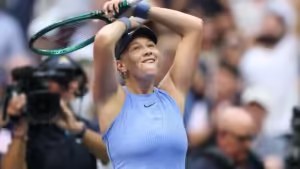
By Florence Baxter
From TikTok trends to clay court controversies, the online presence of tennis professionals is progressively reshaping the sport’s fan experience, alongside player identities.
Social media continues to transform professional sports, acting as a quick and effective method for tournament organisers and governing bodies to provide match and competition updates to keen spectators, and for players to share personal content on and off the court. This medium is especially important in tennis, not just in keeping up with modern progressions, but also as a sport where individual branding is becoming increasingly important. Player fees, from tournament entries to training fees and funding a support team, continue to soar, making it increasingly difficult for many players to break into (and remain on) the professional circuit. Social media allows players to craft their public personas on and off the court- and this can be beneficial in brand engagement too. Support from brands; be it sponsorship, brand deals, or partnering for specific content, is a huge source of funding for tour players. Having a loyal social media following provides evidence of player popularity to brands and helps companies to establish if and how their values align with those portrayed by players, crucial in securing contracts.
Even for world top ten players and big tennis names, these deals are a key contributor to their global success and high estimated net worths. With their huge platforms and social media’s limitless reach, this allows brands to easily monitor their players’ activity, be it promotional or success-related, and helps the most successful players to maintain an income once retiring from the professional circuit. Roger Federer is a prime example. He ranked in the top 10 highest-paid athletes a year after his retirement (Forbes, 2023), Federer has won $130 million in prize money, yet his 10-year, $300 million brand deal with apparel brand Uniqlo alone over doubled his career sum.
The Rise of TikTok:
TikTok has swiftly become one of the world’s most influential social media platforms – and the tennis world is catching on. Previously Instagram and Twitter were favoured by players, with an unspoken pressure to provide polished posts and match day updates after an exhausting day on-court; whereas TikTok is compatible with a more relaxed approach. The platform offers something different – an opportunity for players to better convey their personalities through their short-form content, whilst expressing their spontaneity and humour, showing how they unwind off the court whilst maintaining a close fan connection.
On TikTok, players aren’t just athletes; they’re creators, entertainers and even pranksters. In a new era of relaxed, engaging interviews, with topics far-ranging from the tennis world, these now fill sports feeds, alongside coordinated dance routines with fellow players and team members. Influencing the opinions of fans ‘beyond the baseline’, TikTok helps to give fans a more authentic peek into the life of their favourite players. Player videos on the platform are known to rack up millions of views, often not for showcasing the most ferocious forehand nor the quickest serve, but rather for their relatability and humour. This allows players to appeal to new audiences, gaining reach beyond traditional tennis fans and helping to engage younger audiences, who may not be the first to tune into match day, but will happily scroll through a locker room prank.
In sharing personal content, players regain control of the insights they provide, eliminating risks of misinterpretation or media manipulation from external bodies. This allows players to illustrate and share personal values and causes that really matter to them, on or off the tennis court, to a large, captive fan base.
Four-time Grand Slam champion Naomi Osaka uses her following for positive activism and mental health awareness. Announced as Maybelline’s first-ever Brave Together ambassador towards the end of 2024, Osaka has previously been open in sharing personal struggles with depression and now uses this to empower others, encouraging her followers to put their mental health first and helping to improve access to support.
Beyond personal branding and proving as a powerful tool to broaden appeal, TikTok is helping to promote the sport in its entirety. Organisers and governing bodies such as the WTA and ATP have recently ramped up their social media presence, using the platform to post player challenges, match highlights and interactive content that turn viewers into engaged followers. However, with its fast pace and viral nature; like all social media, TikTok poses challenges in defining a close balance between authenticity and spontaneity, whilst maintaining a level of privacy and ensuring no compromise to sponsorship obligations.
Controversies and challenges:
Nevertheless, social media is not without controversy. Most recently, during the 2025 clay court season, players have been accepting code violations in matches to take photos of ball marks on the court as distrust in the new umpiring system prevails. In an attempt to adapt to a modern era of sport, an electronic line-calling system has been embraced, including on clay courts where, for years, players have relied on ball marks to validate line calls; yet suddenly they are being told not to trust them. The transition is a struggle for many, as illustrated by player backlash on social media platforms to share line call controversies by posting photos of ball marks. Alexander Zverev weighed in on this issue following a third-round code violation for snapping a photo of a ball mark, which appeared to contradict the electronic line calling (ELC) system at the Madrid Open; despite this, he then clarified in an interview that ELC was still his preferred method. Ultimately, Zverev offered the solution that when the ball mark is clear, “then maybe the umpire should be able to come down from the chair… if we’re talking three, four, five centimetres”.
However, despite years of reliance and trust, is a ball mark ever really clear? As explained by the New York Times, a recent campaign on the inner workings of ELC is suggestive that shot trajectory and depth of clay on different court areas can create false marks. Despite this, it must be considered that it is in the interests of the ATP to promote their own system, and a lack of ownership is taken for potential margin of error or system malfunctions. It continues to raise questions that the biggest event of the clay court season, Roland Garros, is retaining traditional line judges this year. This is in spite of the approach of other tournaments, including other clay-court tournaments and grand slams such as Wimbledon which have opted for ELC.
Unsurprisingly, as a platform where spectators and players alike can share views openly, or even anonymously, it becomes ever more difficult for players to escape the sporting world and fame it brings, facing online harassment and increasing public scrutiny. Social media magnifies the lives of players on and off the court. Every expression, outfit or public comment can now be dissected and judged in real time and by a global audience.
While some athletes are learning to set boundaries (by turning off comments, taking breaks or hiring social media managers), the responsibility also lies with platforms, governing bodies and even fans to foster safer online environments. Platforms often claim to have policies against hate speech. Yet, enforcement is usually weak or unreactive, with athletes frequently frustrated at the lack of accountability for anonymous users and difficulty blocking abusive accounts, among other incidents. Prolonged exposure to hate comments and abusive behaviour can severely affect players’ well-being. Mental health issues can arise and even lead to tournament withdrawals, for example, Osaka withdrawing from the French Open back in 2021 following bouts of mental illness. Media pressure can make separations with social platforms difficult, with an expectation for players to speak at press conferences no matter the situation. Media pressure was highlighted in 2021 when Osaka was warned that she could face expulsion from the tournament; before her ultimate withdrawal for refusing to speak with the press during the tournament due to her anxiety. Since then, Osaka has tried to positively capitalise on her media usage to share her mental health journey and inspire others. Public criticism, however, works tirelessly, whether faced by Osaka or others. Since her definitive grand slam win at the US Open in 2021, where she did not drop a set at the tournament, Emma Raducanu has faced criticisms from the media and the British public. They have branded her success story a ‘fluke’ irrespective of her following injury struggles. This is not just confined to the WTA circuit either: recently, Zverev spoke out in response to the media: “I do think the media also loves to put players down, right? I had a bad two months before Munich … all of a sudden, I’m like the worst world No. 2 in the world ever. I don’t deserve to be there. Like, I’m there because I won tournaments. I’m there because I have results.”
The future of tennis and social media:
As the sport of tennis continues to evolve, the integration of social media allows players to shape their identities and enhance their connection with fans in ways previously unimaginable. Social media offers players unparalleled access to fans and career opportunities, but at a steep emotional cost and compromise of privacy.
While the challenges of maintaining tradition in a rapidly changing landscape remain, the benefits of fostering global engagement and personal branding are undeniable. There is little doubt that players and tournament bodies will continue to leverage social media platforms and shape the future of the sport as engagement resultantly increases. Social media is not just a tool; it’s a game-changing element redefining the essence of tennis for future generations.