My Experience Covering the 2024 Wimbledon Championships by Florence Baxter
As an amateur reporter on a smaller channel; it was a privilege to be given the opportunity to cover a grand slam, particularly Wimbledon – our home slam with a myriad of British supporters and stars.
From watching exhilarating matches to the practice courts and behind the scenes, this article will delve into my experience covering the initial stages of the tournament.
As a reporter (and fan), my experience of covering the 2024 Wimbledon Championships felt surreal, and something I never could have anticipated a few months previous. Based at the celebrated grounds of the All England Lawn Tennis Club (AELTC), the electrifying atmosphere and the opportunity to witness and personally interact with some of the best players on the tour – alongside the delicious strawberries and cream (of course a mention couldn’t go amiss) – made this an unforgettable experience.
Behind the Scenes: Practices and Warm-ups
Both during and in the lead-up to the tournament, it will come as little surprise that the practice courts, particularly at Aorangi, are blanketed with back-to-back practices from the pros. Facing players who have already been through a week of qualifying at the National Tennis Centre, for whom the preparation doesn’t stop either, it is of prime importance for players to get the practice in on the grass at the venue prior to their matches, hitting with other pro players and coaches.
From practice matches to coach feeding and drills, attending player practices provided an invaluable glimpse into the hard work and dedication involved in the preparation for such a prestigious tournament. I feel that this is something often overlooked as a home viewer, or even forgotten watching matches on the courtside, but for anyone with a grounds pass looking to attend Wimbledon acts as a good way to get up close and personal with the players – and arguably your best opportunity for photographs and signatures leading up to the tournament.
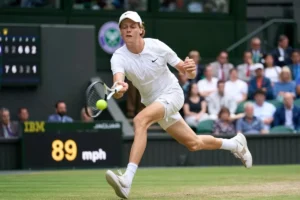
Watching notable players like Maria Sakkari and current World Number One Jannik Sinner fine-tune their techniques and strategies was a lesson in discipline and focus, and gave an insight into player personalities, revealing a different kind of animation to that witnessed during matches. Notably, Jabeur and Sabalenka during their mic’ed up practice on Centre Court entertained fans, highlighting friendships on the tour, and even ended in dancing.
Media Insight: Player Interviews and Press Conferences
For me, indubitably, posing questions to players on the tour in press conferences and group interviews, both pre-tournament and post-matches, was a highlight. As a 20-year-old who’s grown up religiously watching Wimbledon, engaging in such personal interaction with players and being able to gain deeper insights into the thoughts of those in the tournament felt surreal.
Press conferences often provided broader perspectives on the tournament, with players addressing topics from their match performance to their tournament expectations, as well as broader issues and controversies in the sport, notably the current debate of five-set men’s tennis. Operating on a smaller scale, group interviews, most prominent in the qualifying stages of the tournament, allowed us to delve deeper into topics of our choice, with generally greater opportunity to ask more questions.
I had the opportunity to interview and speak with numerous tennis stars including current top 10 ATP and WTA players Daniil Medvedev, Aryna Sabalenka, Elena Rybakina and Ons Jabeur, alongside British wildcard Emma Radacanu, who subsequently completed an impressive run to the fourth round following surgeries last year. Whilst Jabeur commented on the pressure of being a seeded player, especially in the initial tournament stages, Medvedev reflected on his relationship with grass courts and Radacanu touches on how the British crowd playing a home slam “really helped her through crucial moments”.
A notable press conference was that of Stefanos Tsitsipas, two-time grand slam finalist, where I asked him, following his win over Taro Daniel, to discuss his approach to adapting to grass courts, which differ significantly from the preceding clay court season. This is particularly topical as we look forward to the additional (rapid) transition back to clay following the grass court season this year with the 2024 Paris Olympics.
However, it’s not all serious across on Centre Court! In her pre-tournament press conference, before unfortunately withdrawing with shoulder injury, I managed to pose a question to Belarusian star Sabalenka regarding her routines. This focused on her fun and dancing with fellow pro, Jabeur, during their mic’d up practice match on Centre Court – which we’ve previously seen on her social media pages since the beginning of this year’s Roland Garros tournament.
The Matches
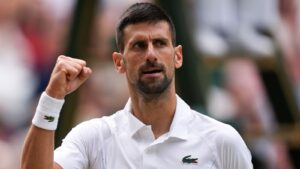
From the moment I stepped onto Wimbledon’s infamous grounds on day one, the energy, excitement and anticipation were palpable – especially as the gates were opened and crowds started to grow. The pristine grass courts and the iconic Centre Court set the stage for some major battles. Watching matches from the press box provided a unique vantage point, allowing me to see the nuances of each player’s game. The intensity of Novak Djokovic’s baseline rallies, the precision of Iga Swiatek’s groundstrokes, and the raw power of Carlos Alcaraz’s serves were a testament to the high level of competition.
From the beginning, it was beyond clear what a match win at the grand slam meant to players, feeling their emotions from the sidelines of the match courts and during press conferences, and similarly channelling the disappointment of others. For British players, this was seemingly exemplified. Playing at their home slam, representing their country, and hearing the roar of the British crowd behind them was a whole new feeling, one which was notable even as a spectator. Radacanu touched on this following her first-round win against Zarazua: “the crowd – nothing really compares to playing on Centre Court”. Despite explaining that this comes with “lots of emotions and nerves” with amplified feelings of pressure, she felt that the crowd really helped her through the crucial moments, and notes that this was something that she missed not playing last year.
For me, one of the standout matches in Round One was that between Alcaraz and Lajal which, despite Alcaraz’s three-set victory, proved a real first-round test for Alacaraz, particularly in the tight first two sets. Here, feeding off the crowd’s energy as the defending champion, Alcaraz displayed his trademark resilience and strategic brilliance. The crowd’s reactions, the ebb and flow of the match, and Alcaraz’s ultimate triumph were all moments that captured the essence of Wimbledon.
The Atmosphere and Culture
Beyond the matches and interviews, Wimbledon’s refined culture added a rich layer to my experience. The traditions, from strawberries and cream to the strict all-white dress code for players, create a unique blend of history and modernity. The respect for the game and its traditions is evident in every corner of the venue and certainly adds to the establishment of the tournament.
From a reporter’s perspective, the camaraderie among journalists, the thrill of capturing a compelling story, and the sheer joy of watching tennis at its finest have made covering Wimbledon a career-defining experience. The 2024 Championships have not only showcased the pinnacle of tennis excellence but have also provided a profound appreciation for the sport and the dedication of those who play it.